
The European Research Council
The creation of the European Research Council (ERC) by the common action of the political institutions of the European Union (the Commission, the Parliament and the Council of Ministers) represents a landmark event for science policy in our continent. By this action, Europe is taking a decisive step towards the formation of a common European Research Area. Listen to Fotis Kafatos, president of the European Research Council at Institut de France. He presents the ERC.
_
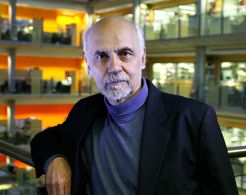
The European Research Council (ERC) is the first pan-European funding body set up to support investigator-driven frontier research.
Its main aim is to stimulate scientific excellence by supporting and encouraging the very best, truly creative scientists, engineers and scholars to be adventurous and take risks in their research. The scientists should go beyond established frontiers of knowledge and the boundaries of disciplines.
The ERC complements other funding activities in Europe such as those of the national research funding agencies, and is a flagship component of the 'Ideas Programme' of the European Union's Seventh Research Framework Programme (FP7).
Being 'investigator-driven', or 'bottom-up', in nature, the ERC approach allows researchers to identify new opportunities and directions in any field of research, rather than being led by priorities set by politicians. This approach ensures that funds are channelled into new and promising areas of research with a greater degree of flexibility.
ERC grants will be awarded through open competition to projects headed by young and established researchers, irrespective of their origins, who are working or moving to work in Europe - the sole criterion for selection is scientific excellence. The aim here is to recognise the best ideas, and retain and confer status and visibility to the best brains in Europe, while also attracting talent from abroad.
But the ERC aims to do more than simply fund research.
In the long term, it looks to substantially strengthen and shape the European research system. This is done through high quality peer review, the establishment of international benchmarks of success, and the provision of up-to-date information on who is succeeding and why.
The hope is that these processes will help universities and other research institutions gauge their performance and encourage them to develop better strategies to establish themselves as more effective global players. By challenging Europe's brightest minds, the ERC expects to bring about new and unpredictable scientific and technological discoveries - the kind that can form the basis of new industries, markets, and broader social innovations of the future.
Ultimately, the ERC aims to make the European research base more prepared to respond to the needs of a knowledge-based society and provide Europe with the capabilities in frontier research necessary to meet global challenges.
Le Conseil européen de la recherche (CER) est une révolution dans la politique scientifique de l'Europe. Il représente la première agence de financement pour la recherche fondamentale, recherche à la frontière des connaissances, qui agit à travers l'Europe (les États membres, les
États candidats à l’Union européenne et des pays associés tels qu'Israël, la Suisse et la Norvège).
Le CER cherche à identifier des projets fortement innovateurs proposés par des chercheurs individuels, indépendamment de leur nationalité, pour travailler dans tout pays de l'Espace européen de la recherche, dans une institution d'accueil appropriée (université, centre de
recherches, etc.). Les projets peuvent se situer dans tous les domaines de la recherche (sciences humaines et sociales, sciences du vivant et médecine, sciences physiques et technologie). Les propositions de projets interdisciplinaires, alliant des domaines scientifiques
spécifiques, sont encouragées. Les propositions soumises sont évaluées uniquement sur la base de l'excellence scientifique, sans que les applications à court terme ni le « juste retour » soient considérés.
Selon la législation européenne dans le 7e programme-cadre, le CER se compose d'un Conseil scientifique autonome (CS), soutenu par une structure de mise en oeuvre spécifique qui a été établie par la Commission européenne et qui devrait devenir une agence exécutive
européenne. Le CS se compose actuellement de 22 scientifiques remarquables, identifiés comme tels par un comité de « sages » dirigé par Lord C. Patten, nommés par le Commissaire J. Potočnik et désignés par la Commission européenne.
L'exposé résume ce que le CER a réalisé en un an d’activité officieuse et neuf mois depuis son établissement officiel. Fotis Kafatos présente également les résultats de son premier appel à propositions : Starting Independent Investigator Grants.
En savoir plus :
- European Research Council
- Fotis Kafatos